Monday, April 16, 2012

80% Chance of Rain


On the corner of the street, under the lamp post, is a ceramic bowl with a dead chicken in it. When we first arrived, nearly 3 weeks ago, the chicken was freshly killed: its head severed, red blood staining the yellow manioc flour underneath it. Now, the bowl is broken, the flour is scattered over the pavement, and the chicken is mostly decomposed. The temperature reaches the upper 80's most days here, but nobody has tried to clean up the mess. This is Salvador da Bahia, Brazil, and that chicken was a curse in the Candomblé religion.

Candomblé is a mix of African (mostly Yoruban) animist religions and Catholicism. It features the worship of orixas (saints), many of whom are closely associated with various Catholic saints. The most important church in Salvador, Bonfim, is dedicated to both Jesus, and Oxala, one of the Candomblé orixas. Salvador is the birthplace of Candomblé, but the religion is currently practiced throughout the African diaspora.
Salvador was the first capital of Brazil during the colonial era. It was, for many years, the main arrival port for slaves entering Brazil. An estimated 1.3 million slaves came to Brazil through the fort which still rests just off the harbor of Salvador. The oldest neighborhood in this city is named after its first function as a slave market: Pelourinho, the whipping post. One of our taxi drivers told us that when he sees a white person, he automatically assumes they're not from here. An American negro, he said, would blend in here better than a whiter person from some other part of Brazil.


We have rented an apartment on Praia da Paciência, a small beach in what's referred to as the 'bohemian' neighborhood of Salvador, Rio Vermelho. Every morning before the sun gets too hot, there's a soccer game on our beach. We can watch from our third floor windows as the ball misses the goal and tumbles into the warm water. During the day, entrepreneurial folk bring down coolers full of beer and set up umbrellas over plastic chairs. For $1 you can buy yourself a drink and some relief from the burning sun. The beach is the great equalizer in Brazil: when all you've got is a speedo or a bikini and the waves, race and class don't matter very much. We learned from the beach vendors that if the weather report calls for 80% chance of rain, it will indeed rain ...for all of five minutes. Then the sun comes right back out again. The dire predictions of the future are never as bad as they seem.

In the evening, the plazas of this neighborhood come alive with food vendors and hundreds of people sitting out in their shorts and tank tops, drinking beer and eating acarajé. The food, like everything else in Salvador, is a remarkable mixture of west African and Brazilian traditions and flavors. Acarajé is a deep fried dough ball made from black-eyed beans and stuffed with dried shrimp and a spicy paste made from ground cashews and hot sauce. It is ridiculously delicious and more than a little messy.

We've had the real pleasure of sharing this space with two great friends who came to visit. Trey journeyed up from Argentina to make his first foray into Brazil, and DiAnn flew all the way down from California to have the coolest spring break of anyone at her school. DiAnn arrived early in the morning on my 34th birthday and made the day one of the most special I've had in a while. Exploring this incredible city with good friends has been quite a way to mark the anniversary of one more year exploring this earth.


Tomorrow we leave for São Paulo, the largest city in South America (and one of the largest in the world). We have a few days to explore, and then we fly to South Africa. It will be fascinating to make the transition from Salvador, with it's rich Afro-Brazilian heritage, to Johannesburg and Capetown, each with its own compelling history and present.


Wednesday, March 28, 2012

No news is bad news. Or, We’re not in Asia anymore, Toto.


In Buenos Aires we had the great pleasure of staying in the San Telmo ‘Ghetto Mansion’ with two of the loveliest boys – our friends Andrew and Trey from Pt. Reyes – who have been living in BA for two years. They showed us around and we basked in the luxury of their home, of Andy’s cooking and friendly relations with the local shopkeepers, and Trey’s extensive knowledge of local politics, history and geography. We got a lot of sun by their rooftop mini-pool (the ‘doggy bowl’), we explored the city, and we had eight flavors of incredible ice cream delivered to the house on multiple occasions (Andrew is my ice cream soul mate).


We had only been in Buenos Aires a few days when the deadline to hear from my most interesting job prospect came and went with no word. I knew what it meant that day, a Friday, but tried to wait until Monday evening to be sure. And there it was: no news is bad news. There are, of course, two possible understandings of this phrase: 1) there is no news that is all bad, and 2) not receiving any word means that it must be bad. I have been trying to understand it as the former. As many in my incredible support network have said to me since then: maybe not getting a job this time around (and this type of job) is a blessing in disguise – maybe it leaves me available for other possibilities to come. I like to think this is the case.


It has been fascinating to note the sense of familiarity (socially, culturally, politically) I feel in Costa Rica, Buenos Aires and Brazil, as opposed to in South and Southeast Asia. Beyond language, which is a major difference (I speak Spanish and Portuguese), both Sage and I have noticed how much easier it is for us to understand what is happening around us and the interactions we have with people on a daily basis. We are not nearly as lost in the fog of wonderment that overcomes so many travelers (Why is she doing that? What does that shrine there mean? Why is the tiller so very long? Why is it called that I wonder? Etc…). Brazil, much more so than Costa Rica and BA even, offers me a sense of home and of belonging. I am so happy to be here using the language I worked so hard to learn and in the place that I have come to love so much over the years.


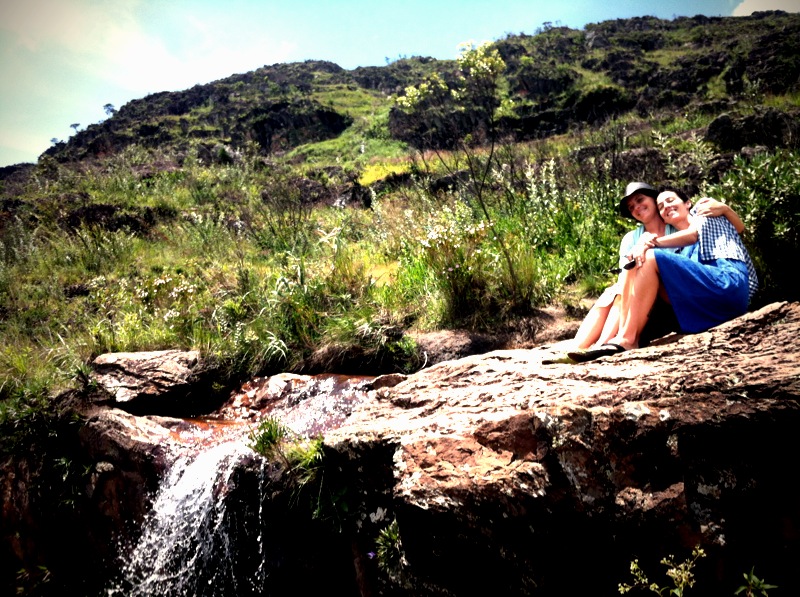
So, we continue our journey. Now we are in the outskirts of Belo Horizonte, Brazil, staying with one of my best friends in the world. Soon we leave for Salvador da Bahia for three weeks in an apartment by the sea. Then, after a few days in the gigantic city of São Paulo, we are off to South Africa. I lived in BH for a summer and then a year in 2001 and 2002-3. One of the things I remember most about living in this city is that it lives up to its namesake – the skyline, the clouds and the sunsets are magnificent nearly every single day. Staying outside the city, we are surrounded by a landscape that is not what people think of when they imagine Brazil, I think. There are rolling green hills, waterfalls, crazy electrical storms and sharp rock formations jutting out of the hillsides. It has been food for the soul to be here with Sage and Luciana as I finish grieving for the end of the academic job search for this year.


Visiting our friends in BA, and then here in BH has definitely inspired us to look with open hearts to the possibilities awaiting us at the end of this trip. One thing we do know now is that I will be returning to India in June to direct and teach the study abroad program for the UW in the Himalayas. Sage is weighing her many options. And then, in August, we hope to land somewhere lovely!

Sunday, March 25, 2012

Buenos Aires Audio Postcard


Also, I've been adding some of our best photos to my flickr page as we go. Search for sagevanwing on Flickr if you care to look at more pictures.

Tuesday, March 6, 2012

What About She?


The adjectives that come to my mind to describe Costa Rica are the same as they were when I traveled here in 1998: easy and beautiful. It is easy to get around, to communicate, to find delicious and clean food. And despite the immensity of the tourist industry, this country remains incredibly beautiful. I was last here for my 19th birthday. At that time, Costa Rica was the perfect introduction to the start of a three-month trip in Central and South America- my first time traveling outside of the United States. Now, it’s a lovely break after an intense couple of weeks of interviewing for academic jobs and being in New York City. And it’s a perfect beginning to the third segment of our big trip.


So far we have seen a pair of sloths and a pair of toucans, several tiny Poison dart frogs, a Jesus Christ lizard (we are not sure why it is called that, but we’ve had fun imagining), endless colors and sizes of butterflies, and we have heard Howler monkeys, who give the impression that we are surrounded by a forest filled with roaring beasts, perhaps dinosaurs. The frog sounds at night are like a synthesizer gone wild.


It rained all night in that tropical way- as though someone had rent a hole in the awning of the heavens and the water just came pouring through. This morning, the jungle is dripping around us, the sky is grey and blustery, and the ocean is seething. We are amazed at how much water the earth can absorb. I left my book outside last night and now it is a swollen, pulpy mass. I’ve come out to the beach to read, but everything is damp, so I’ve set it to dry on the log beside me and the wind ruffles through the pages.


There are coral reefs here just offshore, but the waves have been too high the last few days to try snorkeling. Today will not be the day for it either. It’s been sunny, though: humid and warm and we have played in the waves with the Costa Ricans who flock to this beach on the weekends and the other white tourists and local kids who are here during the week. The kids yell back and forth to each other over the waves in a mixture of Spanish and a Jamaican-style Creole.


In the late 1800’s, many Jamaicans were recruited to work on the railroads and banana plantations of this coast and the Afro-Caribbean culture is strong here. Yesterday we ate jerk smoked chicken at Miss Edith’s Restaurant in Cahuita. It was truly one of the best meals of my life. When Sage walked over to the ocean to wash out a spot of jerk sauce from her shorts, Miss Edith came over to take away my plate. I ordered a ginger cake for dessert and she gestured to the empty chair, saying, “what about she?”


The darker skinned folks all seem to speak in a patois to each other, and in Spanish to everyone else. Though the patois is based on English, it is impossible to understand, but very very cool to listen to. At the bar in town the other night we felt invisible – which was kind of cool – so we tried to listen to the conversations around us at the dominoes table and around the bar.


The last few months of travel through Southeast Asia have been fast-paced and exciting. We’ve traveled to places neither of us had ever been in countries whose languages we don’t speak and with whose cultures and food we are largely unfamiliar. Now we begin a different kind of travel. We will be visiting friends. We will be staying places longer- settling in a bit and developing a routine. One or the other of us will be familiar with the languages. We will be visited by friends.


Though our time in New York was made stressful by job interviews and conferences, it was made rejuvenating by friends. It was the first time since we had been in India that we really had anyone to talk to besides each other. It was the first time since we left home that we got a chance to talk with people who truly know us well (both in person and on the phone). We look forward to visits from friends in the upcoming months. We both left New York feeling incredibly blessed by the friendships we have in our lives.


--Kacy and Sage


Friday, February 10, 2012

The King Likes BoyScouts

I'm back in Bangkok, taking a Thai massage course. It's intense, wonderful, relaxing, and challenging all at once. The class is offered at a Buddhist temple called Wat Pho, which boasts the largest reclining Buddha in Thailand. As you might imagine, he's a happy looking fellow.


The temple itself is all spires and pointed rooftops covered in ceramic, mirrored, and golden tiles. Images of dragons and peacocks abound (I think of Amanda every time I pass one particular peacocked wall). The gold and the mirrors reflect the sun and everything and everyone inside glitters. It's breathtaking in the morning light.


The massage classroom is packed full of mats and students and instructors. We alternate massaging, and serving as models for fellow students. Since the full massage sequence takes an hour an a half, sometimes you're just lying there on a mat for a good portion of the day. I've spent the last five days massaging all sorts of different people: a Thai woman who lives in Germany and wants to start a massage place there because "German people are so uptight;" an Italian masseuse from Genova looking for a new style; a Chinese acupuncturist from Szechuan province who wanted to learn about Thai pressure points; a Swiss guy who was on a sort of Eat, Pray, Love kick (he had been meditating in India for several months before this); a French cabinetmaker with a truly incredible mustache that made all the girls giggle; a Greek fellow who said he doesn't really have a country because he now lives in the part of Cyprus claimed by Turkey but admitted by no one; and of course all the many Thai women who have come to get their foot in the door of what can be a very well paying industry. A massage here costs roughly $6/hour. The masseur keeps less than half of that.

The instructors speak a little English, but mostly manage to communicate to all of us by roughly pulling and pushing and prodding us into the right position. They are incredibly physical people. They grab your hand when you come in the door and lead you around the room. If they're bored for a moment watching a fellow student practicing step 3, they're likely to pick up whatever limb is closest and start kneading it. You may find yourself getting worked on by three people at once. There are a few stock phrases you hear echo throughout the room- "palm press," "sit up please," "second line." This last one because there are always two lines of points along any limb, and people often forget and stop at the first. Every time they shout out "second line! second line!" it makes me think of the funeral parades in New Orleans (and Milissa, of course).

I find that I have to stop thinking to do the massage properly. If I concentrate too hard on what step comes next, I lose track of where I am completely. And if I start wandering off and daydreaming about something else, I forget what step comes next. I think it's the closest I've ever come to "being in the moment." Except when I'm hiking, of course.

What I love about a long walk is that all the overcrowded thinking in my brain eventually falls away. At first I have more space to think (and then it's a good place to work through problems), and then I have space to daydream. But then, when there's nothing left to think or daydream about, I reach a kind of zen place. It's just "there's a rock," "that must be an egret," "the light is gorgeous here," but not even enunciated that clearly inside my head. A river of thoughts, and myself walking slowly through them all, leaving them aside. As someone who spends entirely too much time thinking, a long walk every now and again is a necessity.

And now it seems that I can get to that same place by giving a massage. Indeed, it seems to be the only way I can do it properly. It's been a very strange couple of days here in this room at Wat Pho in Bangkok. Slowly pushing and prodding and touching other people, and not thinking very much at all.


My walk home from the class passes the Thai Police Shooting range. The cracking of the pistols has a way of jolting one out of a massage induced reverie (though my next thought is always to wish I could test out my aim). Next door to the shooting range is another training ground- this time for Thai boyscouts. The King of Thailand has decreed that all Thai children participate in a program modeled on the Boy and Girl Scouts of America. Young boys in brown uniforms with yellow knee socks flood the sidewalk in the afternoons.


My hotel is in Chinatown- a bustling neighborhood chockablock with street markets of all sorts (every time I see flannel pajamas for sale, I want to buy them for Chicu, who went to such lengths to have them made in India). The food stalls spill over into the sidewalks at night and the selection is mouthwatering, from sweet and savory snacks to full course meals barbequed, grilled, deep fried, or roasted right there on the street. My favorite so far: custardy persimmon cupcakes with fresh coconut on top, steamed over a boiling vat of water on the sidewalk. (I think you could do a great version of these, Claire.)


(all of SouthEast Asia makes Seattle's sidewalk cafe rules look ridiculous)

My window is right across the street from Hi-Fi alley, where folks come to buy good speakers. The stores display their wares by blasting Thai pop hits onto the street. I'm not sure how anyone can determine a quality sub-woofer in the resulting cacophony, but they seem to do a brisk business. Fortunately, I'm not in my room much during the day.


It's entirely possible to be drenched through with sweat in just the few short blocks between the Wat and my hotel. Bangkok, at this time of year, is a three-cold-showers-a-day kind of a place. When we first arrived in the city three weeks ago, it was raining every afternoon- torrential downpours of the kind that would clear the sidewalk immediately, everyone waiting until the rain was through before continuing on their way. There was rain every day for a several weeks. People everywhere were telling us it never rains in January or February. I began to be worried about floods.

This city is built on a swamp, really. The river is tidal- once a month at the full moon it pours over into the streets. Yesterday, my taxi driver made me get out and take a canal water ferry instead because the traffic was so bad. Much of the southern part of this country flooded quite badly last fall. You can still see the high water marks all over Bangkok. Yet, everyone I talked to said they weren't worried about floods now. This rain will pass, they said. That doesn't mean they don't think it will flood again during the next rainy season, despite the assurances of the government. They seem quite sure that it will. Bangkok is sinking at a rate of 3cm per year.

At least the rain had a way of taking the edge off the heat for a bit. Now it is just thick and hot and bright all day. Today it was 92 degrees. Believe it or not, even I am learning to walk slowly. More slowly, anyway. I guess it's about reaching that zen kind of a place.


Tuesday, February 7, 2012


In my first day or two in Singapore I kept mulling over this latent desire to be in fashion. After a bottle of sake to myself I watched shows and movies about fashion, hungering over what I don’t want to miss out on in my life. But today, looking at art, buying a new pen and some special watercolor paper, I remember that with art I can do many of the other things I long to do.

I see artists using illustration and animation to make fine art with powerful messages. I see them using patterns and textures to make something even more interesting to me than fabric. I see them telling me that if I just let myself get better and try to open myself up, I can fulfill those latent desires.


The art housed in the Singapore Art Museum (SAM) is filling me (once again) with the power of art to be political, to bring awareness, to look critically across time and space. There is a series of photographs and a short film called “Bomb Ponds” by Vandy Rattana, which appears at first to be everyday nature scenes in Cambodia, until you read the description and find that these are ponds created by bombs dropped by the US on neutral Cambodia – this was particularly poignant to me after having recently being there, and knowing that the signs must have been all around us.

In the next room at SAM there is an incredible mural - “Baston ni Kabunian, Bilang Pero di Mabilang” by Rodel Tapaya - that depicts greed and folly through stories originating in 300 years of Spanish colonial rule of Philippines.


Another series “Needling Whisper, Needle Country/Embroidery Project” from the South Korean artist Kyungah Ham, was so moving that I had trouble standing. This is a series of large embroidered pieces created through sending coded instructions and digitally composed images on a 1:1 scale by third-party couriers (to avoid detection by the authorities). The images and instructions were sent to North Korea where they the pieces were embroidered in extraordinary detail. In the process some of the pieces were confiscated, and several were under suspicion of their messages.

One of the missing links in bridging my art and my academic work is my difficulty in allowing myself the time necessary to establish a style and enough freedom to be political in my art. The walls that inhibit me artistically are certainly self-made.

I have been putting my related hopes into one of my job applications in particular, in the Critical Studies program at California College of the Arts. Telling myself that if I get that job, I will create the space to live this art and academic life together. But as the weeks pass and I do not hear from them, I realize I need to find a way to make this happen wherever we end up. I don’t just want this; I need it. The image of one of my early graduate school advisors comes into me head: pushing me, telling me that the only way to do this, to really do academia, is to put everything else aside. I did that. I put my art aside. I put my creativity aside. This is making me tear up just to write it. Towards the end of graduate school, I brought some of this back, I made time to volunteer, and very importantly, I worked on a (forthcoming!) graphic novel about jellyfish with a friend, I started to draw a little more.

In India last fall I let the people around me see my work, I tried to draw as often as possible, to make it a habit again, to call myself an artist. As we have traveled in Fiji and South East Asia, I have done some drawings and paintings, but not yet as much as I had hoped. My goal, for the coming months, as Sage and I continue our travels, is to create the space to really dive into my art, whether it is through working on the graphic novel about my field research or through other projects, it doesn’t matter.


Sage told me a few months ago about how a friend of ours in San Francisco got together with a group of people to work on comic books – they holed themselves up for 24 hours, and each drew 24 pages. It’s hard to explain how this made me feel. I want that! I want that group of people around me; I want that time; I want to try it! Which of course means prioritizing it. There is a part of me that is absolutely desperate to begin the struggle that will be finding myself as an artist.

Over the next few weeks, as I interview for jobs, I will try to keep this in my mind. How can I make the space in my academic life to fully explore my artistic life?

Thursday, February 2, 2012

Bridging the Gap


We went to a spa in Bangkok. It had been hot and humid and suddenly it was raining- the kind of torrential rain that only a tropical climate can produce. It seemed silly to try to do anything outside, so we hopped on the skyway and soon found ourselves confronting a menu of options for relaxation: traditional Thai massage, foot reflexology, oil massage, hot herbal compress, mud body mask. The women at the spa spoke no English, but the language of the place was familiar to us. Nearly every woman I know in the US has gotten a massage or two in their lives. In the last few years, Kacy and I have made a ritual of going to the Korean women’s spa outside of Seattle and I think we managed to take most of our friends there with us. The idea that women will go to spas to ‘pamper their bodies’ has now become commonly accepted in the US. In other countries it’s understood that this is something both men and women should do. I sat in public baths with whole families in Iceland and Hungary, and the men’s side of the Onsen in Japan is just as full as the women’s. But in America, at least, I don’t know many men who get massages, or sit in the steam room (except gay men, of course)- it is still primarily a woman’s realm.

So when the women at the spa in Bangkok led us into a room, we knew to take our clothes off and lie on the mat. And when they began pummeling our bodies, it felt immediately familiar. It felt, in fact, like we were crossing a giant communication barrier. We couldn’t speak the same language, but our bodies, ultimately, were the same as theirs. Our muscles strained in the same ways, our backs cracked with the same motion. The pure physical contact was immediately universalizing.

Of course, as I lay there in a Bangkok massage parlor feeling pleasure and familiarity in the physical contact of another person’s body, I couldn’t help but think about the sex industry. Bangkok’s red light district is famous. The sex industry’s annual turnover is nearly double the Thai government’s annual budget. I have heard it said that Thai’s are much less uptight about sex than Westerners. Does this universalizing feeling of human bodies come into play there too? Is sex a way for men to bridge the communication barrier as well? The language of sex does seem to be fairly universal, after all.

I’m not at all suggesting that this is the whole reason for this huge multi-faceted sex industry. There are so many different reasons why women get into this business (or are forced into it) and why men go looking to pay for sex… and I’m certainly no expert on the subject. But it’s hard to ignore that it’s here, after all. While getting massaged in a place like Bangkok, it’s impossible not to wonder: does the sex industry give Western men something of what massage can give women? And what is this exchange like for the Thai women who are involved?